
Description
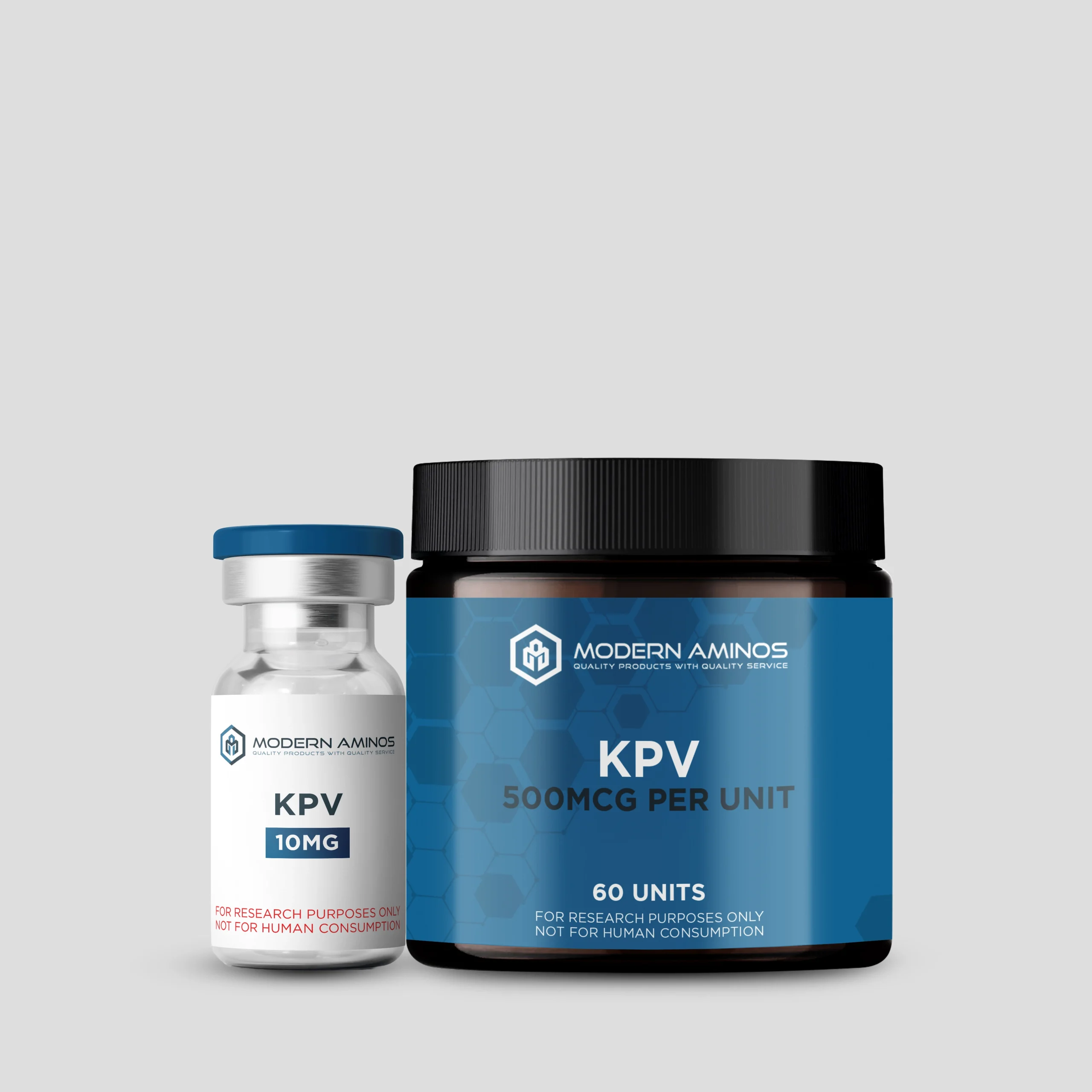
Buy KPV Peptide
KPV is a naturally occurring tripeptide derived from alpha-melanocyte-stimulating hormone (alpha-MSH) — one of the most extensively researched anti-inflammatory and immunomodulatory peptides in current biochemical science. KPV peptide works by directly inhibiting NF-kB, the master regulator of inflammatory signalling, reducing pro-inflammatory cytokine production at the cellular level and restoring physiological balance in inflamed tissue.
Unlike broad-spectrum anti-inflammatory compounds, KPV achieves precise, targeted modulation of immune and inflammatory pathways without suppressing overall immune function. This makes KPV uniquely valuable in research contexts where selective intervention in inflammatory cascades is required without compromising the body’s adaptive defences.
KPV Peptide Benefits
- Potent anti-inflammatory action: KPV directly inhibits NF-kB activation — reducing the production of TNF-α, IL-6, and other pro-inflammatory cytokines that drive chronic and acute inflammation
- Immunomodulation without immunosuppression: KPV fine-tunes immune responses rather than suppressing them — supporting a balanced, resilient immune environment in research models
- Gut and mucosal barrier support: KPV demonstrates significant protective and reparative effects on intestinal epithelial tissue — making it one of the most researched peptides for gut barrier integrity and IBD-related models
- Tissue repair and cellular regeneration: KPV promotes accelerated tissue healing and cellular repair, with applications in wound healing, skin health, and mucosal recovery models
- Neuroprotective properties: Emerging research indicates KPV may modulate neuroinflammatory pathways, with potential applications in CNS inflammation research
- Skin anti-inflammatory research: KPV’s alpha-MSH derivation gives it relevance in dermatological research contexts, with observed reductions in skin inflammation markers in studied models
KPV Mechanism of Action
KPV operates primarily through inhibition of the NF-kB signalling pathway — one of the most fundamental inflammatory regulatory mechanisms in mammalian biology. By blocking NF-kB nuclear translocation, KPV prevents the transcription of downstream pro-inflammatory genes. This results in measurably reduced cytokine output, decreased leukocyte infiltration into inflamed tissue, and faster resolution of the inflammatory response. Additionally, KPV modulates melanocortin receptor activity (particularly MC1R and MC3R) — the same receptors through which alpha-MSH exerts its anti-inflammatory and immunomodulatory effects.
This dual mechanism — NF-kB inhibition plus melanocortin receptor modulation — gives KPV a broader anti-inflammatory reach than many single-mechanism compounds. For researchers exploring gut inflammation, KPV has demonstrated particular efficacy in intestinal epithelial models. KPV directly protects tight junction integrity, reduces gut permeability, and accelerates mucosal healing — making it a compound of significant interest in IBD, leaky gut, and colitis research.
KPV Specifications
| Attribute | Details |
|---|---|
| Product Name | KPV Peptide |
| Sequence | Lys-Pro-Val (tripeptide) |
| Origin | C-terminal fragment of alpha-MSH |
| Category | Anti-inflammatory / Immunomodulatory Peptide |
| Form | Lyophilized powder |
| Purity | ≥99% (HPLC tested) |
| Typical Research Dose | 0.5–1mg per administration (research models) |
| Administration | Subcutaneous injection or oral (research use) |
| Storage | Refrigerate at 2–8°C; use within 28 days of reconstitution |
| Use | Research purposes only |
KPV Peptide Research Applications
KPV is primarily researched in the following contexts:
- Inflammatory bowel disease (IBD) models: KPV is one of the most studied peptides in intestinal inflammation research, with multiple models demonstrating significant reduction in colitis severity and mucosal damage
- Wound healing and skin inflammation: KPV’s anti-inflammatory and tissue-regenerative properties make it relevant in dermatological research, particularly for inflammatory skin conditions
- Gut barrier permeability: KPV protects epithelial tight junctions and accelerates mucosal repair — relevant for leaky gut and GI permeability research. For GI protection alongside GLP-1 peptides, KPV is often studied alongside BPC-157
- Systemic inflammation: KPV’s NF-kB inhibition has broad relevance across inflammatory disease models beyond the gut
- Neuroinflammation: Emerging data suggests KPV may have applications in CNS inflammatory pathway research
KPV Stacking in Research Protocols
- KPV + BPC-157: Combined gut and tissue repair protocol — KPV targets NF-kB-mediated inflammation while BPC-157 drives angiogenesis and growth factor upregulation for tissue healing. Also available as the Glow Stack
- KPV + L-Glutamine: Dual gut barrier support — KPV reduces gut inflammation while glutamine fuels intestinal epithelial cell repair and maintains tight junction integrity
- KPV + TB-500: Systemic anti-inflammatory + actin upregulation for comprehensive tissue repair and inflammation resolution
- KPV + GHK-CU: Anti-inflammatory + collagen synthesis combination for skin, wound, and connective tissue research protocols
- GLP-1 protocol GI support: KPV oral administration studied alongside Semaglutide or Tirzepatide to address GI inflammation and mucosal sensitivity during GLP-1 initiation. Read our GLP-1 GI support guide
KPV FAQ
What is KPV peptide used for in research?
KPV is primarily researched for its anti-inflammatory, immunomodulatory, and gut-protective properties. Its most studied application is in intestinal inflammation and IBD models, where KPV consistently reduces inflammatory markers, protects mucosal integrity, and accelerates healing. KPV is also studied in wound healing, skin inflammation, and systemic inflammatory pathway research.
How does KPV differ from BPC-157 for gut research?
KPV and BPC-157 both demonstrate gut-protective properties but through different mechanisms. KPV works primarily via NF-kB inhibition and melanocortin receptor modulation — directly reducing inflammatory cytokine production. BPC-157 works primarily through angiogenesis promotion and growth factor upregulation — driving physical tissue repair. They are complementary and are often combined in gut recovery research protocols.
Can KPV be taken orally?
Unlike most peptides which are degraded by gastric acid, KPV is a small, stable tripeptide that demonstrates oral bioavailability in research models — making it one of the few peptides with documented effectiveness via both oral and subcutaneous routes. Oral administration is particularly relevant for gut-targeted research where local intestinal delivery is desired.
How should KPV Peptide be stored?
Lyophilized KPV powder: refrigerate at 2–8°C, away from light and moisture. Once reconstituted with bacteriostatic water: refrigerate and use within 28–30 days. Never freeze reconstituted solution. See our full storage and reconstitution guide.
⚠️ Research Use Only: KPV peptide is sold strictly for laboratory and scientific research purposes. It is not intended for human consumption, ingestion, or in-vivo use. This product is not a dietary supplement and has not been evaluated or approved by the FDA for human use.
Reviews
There are no reviews yet.